

3.1 Japan’s Health Insurance System
Overview of the Health Insurance System
The Constitution of Japan stipulates the right of citizens to maintain a minimum standard of living and clearly establishes the obligation of the State to develop the necessary environment, including the construction of social security systems. Within the health and medical care sector, the public health insurance system constitutes a core component of social security. Its principal characteristics are universal health insurance coverage and free access.
Universal health insurance refers to the principle that, in principle, all residents are enrolled in some form of public health insurance scheme. Regardless of nationality, all individuals who are recognized as residing in Japan for a period exceeding three months are required to enroll in a public health insurance scheme. The specific public health insurance scheme to which an individual belongs is determined by factors such as occupation, age, and place of residence, and cannot be freely chosen by the individual. Furthermore, where the insured person is not the head of the household, enrolment is determined based on the occupation, age, and place of residence of the household head.
Irrespective of the health insurance scheme to which an individual belongs, patients are free to choose medical institutions and the frequency of consultations at their own discretion. This system is referred to as “free access.” As the vast majority of medical institutions in Japan are registered as providers under the public health insurance system (insured medical institutions), insured individuals are able to receive necessary medical services with a uniform level of cost-sharing, regardless of their insurance scheme (see Section 1.2).
Status of the Various Health Insurance Schemes
Japan has more than 3,000 insurers, broadly classified into three categories: employment-based insurance, community-based insurance, and the Medical Care System for the Latter-Stage Elderly. Individuals aged 75 years and over are enrolled in the Medical Care System for the Latter-Stage Elderly. Those under the age of 75 are enrolled either in employment-based insurance or community-based insurance. Community-based insurance functions as a safety net for individuals who are not eligible for any other public medical insurance scheme.
Employment-Based Insurance
Employment-based insurance primarily provides medical coverage for regular employees and their family members. It should be noted, however, that not all regular employees are eligible. For example, individuals employed by establishments with fewer than five employees are excluded from employment-based insurance and are instead enrolled in community-based insurance. Insurance premiums are calculated by applying the premium rate to the standard monthly remuneration, which categorizes the monthly wages and other remuneration received from the employer into predetermined income brackets.
Employment-based insurance is mainly divided into two types: Health Insurance Societies and the Japan Health Insurance Association (Kyōkai Kenpō).[1] As of the end of March 2023, there were 1,383 Health Insurance Societies, all of which are public corporations established under the Health Insurance Act. These include societies established by a single company (single-company societies) and those formed by employers within the same or similar industries (general societies). As of the end of March 2023, the total number of insured persons was 28.2 million.
Kyōkai Kenpō is a single nationwide insurer established under the Health Insurance Act to provide coverage for employees and their families working in small- and medium-sized enterprises for which establishing a Health Insurance Society is difficult. However, premium levels vary by prefectural branch. In addition to premiums paid by insured persons, premiums transferred from Health Insurance Societies and government subsidies constitute the main sources of funding for Kyōkai Kenpō. As of the end of March 2023, the number of insured persons stood at 39.44 million. In cases where a Health Insurance Society is dissolved due to financial difficulties or other reasons, its insured members are transferred to Kyōkai Kenpō. In this respect, Kyōkai Kenpō fulfils a safety-net function within the employment-based insurance system.
Mutual Aid Associations are insurers established under the respective Mutual Aid Association Acts for national public servants and related groups. As of the end of March 2023, there were 85 such associations, with a total of 9.83 million insured persons. As with Health Insurance Societies, premium levels vary depending on the specific Mutual Aid Association.[2]
Community-Based Insurance
The National Health Insurance (NHI) scheme is a health insurance system primarily intended for the self-employed, the unemployed, and retirees under the age of 75. In other words, it functions as a safety net for health insurance coverage by enrolling residents who are not covered by any other medical insurance scheme.
While municipalities were originally the sole insurers of the NHI, prefectural governments were added as insurers from fiscal year 2018. As a result, the system is now administered through a two-tier structure in which prefectures and municipalities share responsibilities. Prefectures play a central role in ensuring stable fiscal management and the efficient operation of the scheme. Municipalities, by contrast, undertake locally tailored activities in close relationship with residents, including eligibility management, the provision of insurance benefits, the determination of premium rates, the assessment and collection of premiums, and the implementation of health promotion programs.
Compared with employment-based insurance, the disease risk among insured persons is higher and income levels are lower, and consequently the financial condition of community-based insurance is a persistent concern. Owing to factors such as the relatively advanced age structure of enrollees, low-income levels, and low premium (tax) collection rates, the scheme may be characterized as financially unstable.[3] Unlike employment-based insurance, in which premiums are shared equally between employers and employees, insured persons under community-based insurance must bear the full cost of premiums themselves, resulting in a relatively high premium burden in relation to income. Premium rates are determined on a regional basis.
The Healthcare System for the Latter-Stage Elderly
As noted in Section 1.3, the Medical Care System for the Latter-Stage Elderly was introduced in 2008 and covers all individuals aged 75 and over. Under this system, there is no distinction between dependents and insured persons; all participants are insured in their own right. The scheme is administered by wide-area associations formed by municipalities at the prefectural level.
Premiums are collected through automatic deductions from individuals’ pension benefits. However, premiums account for only around 10 per cent of total revenue, and the system is therefore sustained through public funding and fiscal adjustments with the two aforementioned medical insurance schemes.[4]
Medical Benefits and Patient Cost-Sharing
Although Japan’s public health insurance system is divided into multiple schemes, the content of medical benefits and the cost-sharing rates borne by patients are standardized. This standardization ensures equity of access. In principle, the scope of medical benefits is the same across all public health insurance schemes, and thus disparities in benefit entitlements based on insurance affiliation are largely absent. The public health insurance system broadly covers standard medical treatments, while advanced medical technologies are progressively included once their effectiveness and safety have been verified. As a result, it is generally considered possible to receive appropriate medical care without enrolling in supplementary private insurance.
The standard patient co-payment rate for medical expenses is set at 30 per cent across insurance schemes. However, age-based reductions apply: children under six years of age (prior to compulsory schooling) are subject to a 20 per cent co-payment, individuals aged 70 to 74 also pay 20 per cent, and low-income individuals aged 75 and over pay 10 per cent.[5] Depending on income level, some individuals may not qualify for these reduced rates. In addition, certain health insurance societies and local governments operate programs that subsidize part of patients’ out-of-pocket costs. A representative example is the municipal child medical expense subsidy program.
The High-Cost Medical Expense Benefit System
To prevent excessive financial burdens on households when medical expenses become high, the High-Cost Medical Expense Benefit System provides reimbursement for amounts exceeding a monthly out-of-pocket ceiling. The ceiling varies according to the insured person’s age and income level. For example, for insured persons under the age of 69 with an annual income of approximately ¥3.7 million to ¥7.7 million, the monthly ceiling is calculated as ¥80,100 plus 1 per cent of the amount exceeding ¥267,000 in medical expenses. This system plays a significant role in protecting patients from financial risk (financial risk protection).[6]
In fiscal year 2022, benefit payments under this system amounted to approximately ¥2.13 trillion for those under the age of 75 and approximately ¥836.2 billion for those aged 75 and over. Over the ten-year period from 2012 to 2022, both the number of claims and the total amount paid increased by approximately 1.37 times. Overall, expenditures under the High-Cost Medical Expense Benefit System have continued to rise, and discussions are underway regarding revisions to the out-of-pocket ceilings.[7]
Revenue and Expenditure by Health Insurance Scheme
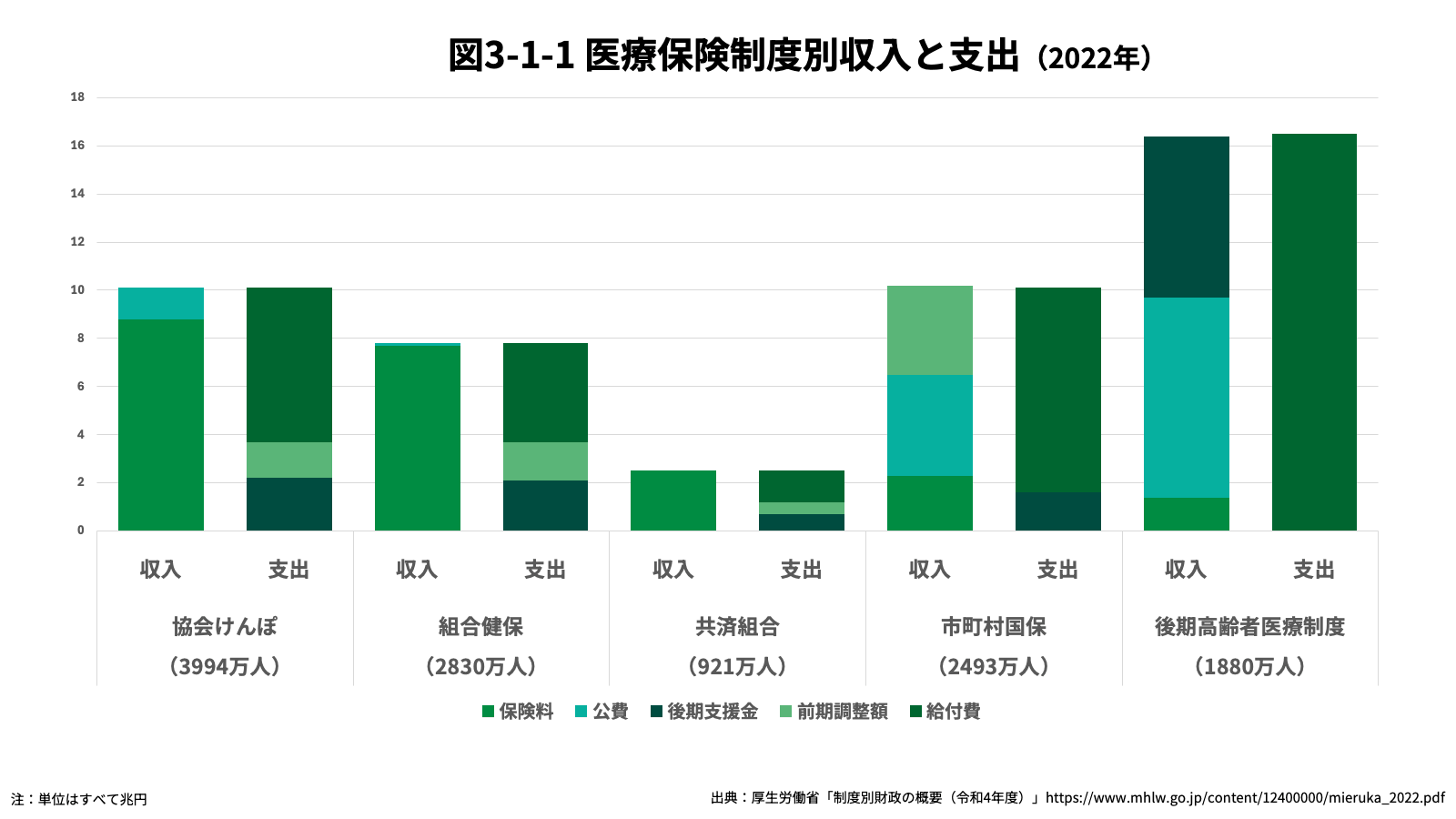
As shown in Figure 3-1-1, expenditures by the Japan Health Insurance Association (Kyōkai Kenpō), society-managed health insurance, and mutual aid associations, such as contributions for the support of the latter-stage elderly, contributions for the pre-latter-stage elderly, and retirement-related contributions, are transformed through inter-insurer fiscal adjustment into revenues for other schemes. These include grants for the latter-stage elderly medical care system, grants for pre-latter-stage elderly coverage within municipal NHI, and retirement-related grants.
Figure 3-1-1 also illustrates that the proportion of revenue derived from insurance premiums and national government contributions, as well as the proportion of expenditure devoted to benefit payments, varies considerably across insurers. As is evident from the table, national government contributions account for a substantially larger share of revenue than premium income in both the latter-stage elderly medical care system and the NHI. This heavy reliance on central government funding underscores the severity of the challenges facing their fiscal management.
Structure of the Elderly Healthcare System
The structure of healthcare for older people is complex. This is because it deviates significantly from the basic insurance principle whereby premium income and insurance benefits are balanced, relying instead on financial support from other medical insurance schemes. Older people constitute a vulnerable group with high disease risk but relatively low-income levels; therefore, by accepting financial support from the working-age population, the system forms part of a broader social security framework in which society as a whole ensures access to healthcare. Separate systems are implemented for the “young-old” (aged 65–74) and the “old-old” (aged 75 and over).
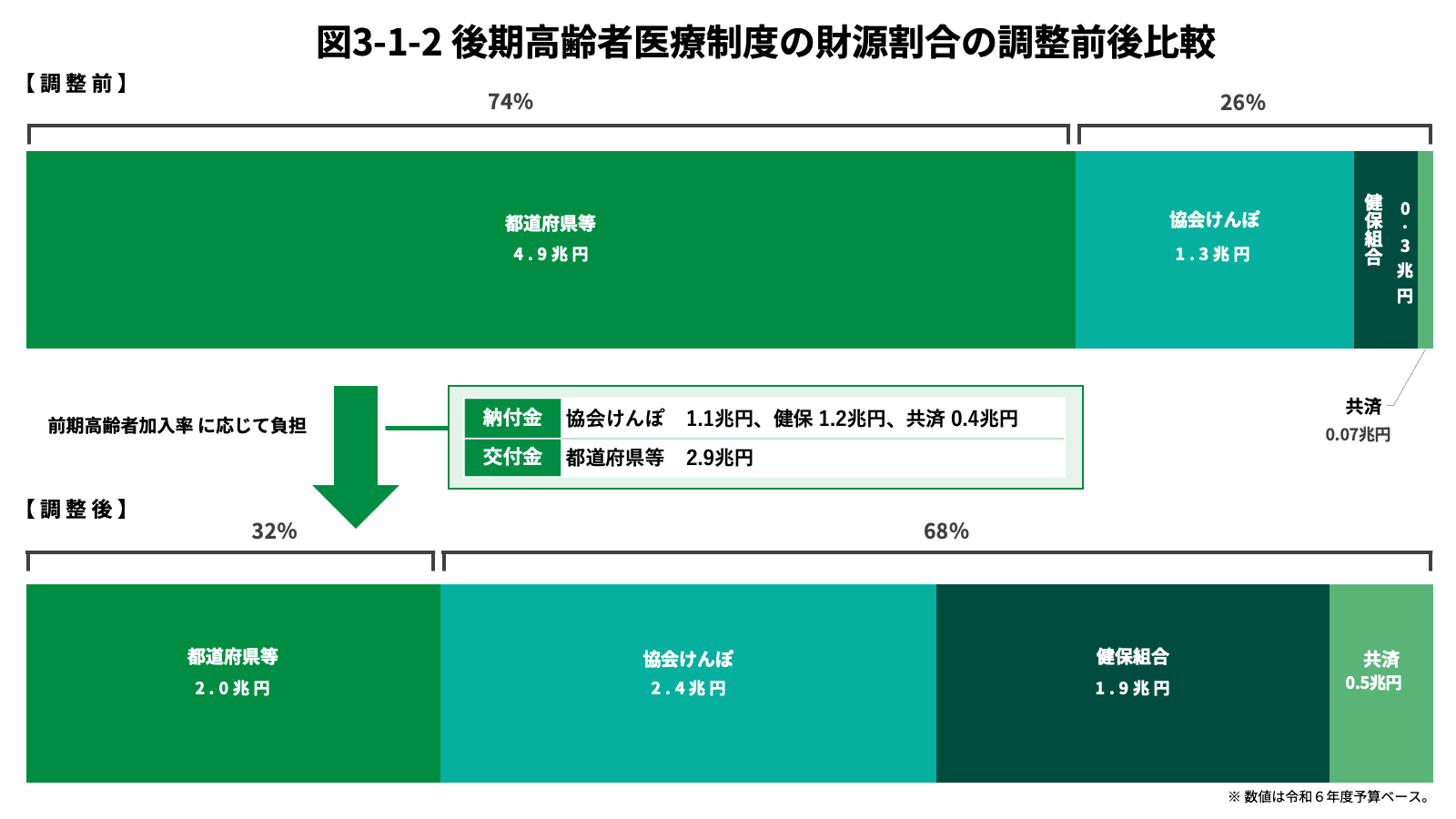
The financial adjustment mechanism for the young-old is designed to correct imbalances in the burden borne by insurers that arise from the uneven distribution of individuals aged 65–74 across insurance schemes. Contributions are adjusted according to each insurer’s proportion of young-old enrollees. As a result, unlike the system for the old-old, individuals aged 65–74 remain members of their respective health insurance schemes.[8] As shown in Figure 3-1-2, prior to the introduction of this financial adjustment, more than 70% of healthcare benefit costs for the young-old were borne by municipal National Health Insurance schemes and similar insurers, with the remaining insurers covering just under 30%. Following the implementation of financial adjustment, these inter-insurer imbalances are corrected, resulting in a cost-sharing structure in which approximately 30% of young-old benefit costs are borne by municipal National Health Insurance schemes and around 70% by other insurers.
Funding Sources of the Late-Stage Elderly Healthcare System
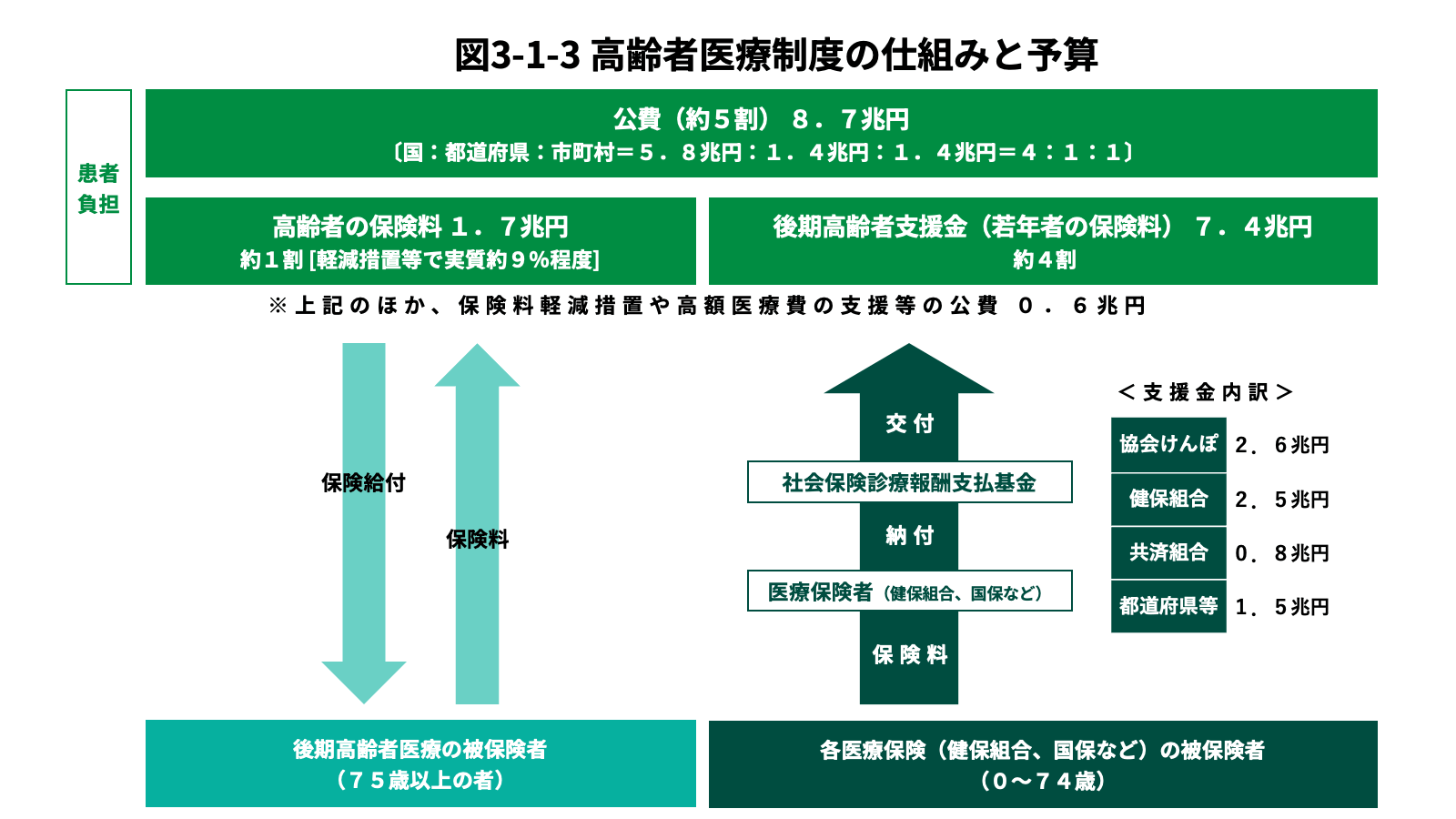
As shown in Figure 3-1-3, the funding sources of the Late-Stage Elderly Medical Care System consist of approximately 50% public funding (national government: prefectures: municipalities = 4:1:1), around 40% support contributions from each insurer, namely, insurance premiums paid by the working-age population, and roughly 10% insurance premiums paid by older persons themselves. The scale of medical expenditure for the late-stage elderly amounts to a total of ¥18 trillion in FY2022, comprising ¥16.5 trillion in benefit payments and ¥1.5 trillion in patient out-of-pocket payments.[9][10]
In principle, the support contributions financed by insurance premiums from the working-age population are apportioned based on the number of enrollees (aged 0–74) covered by each insurer. As this allocation is determined solely by enrollee numbers, it imposes a particularly heavy burden on insurers with weaker financial capacity. To ensure that cost-sharing better reflects the ability to pay, the allocation method among employee-based insurers has been gradually revised through the introduction of a “total remuneration-based” approach. Specifically, the proportion based on total remuneration was increased to one-half in FY2015, to two-thirds in FY2016, and has been fully based on total remuneration since FY2017.[11]
The Structure of Insured Medical Care in Japan
This section explains the mechanism through which medical expenses are paid when insured persons receive care at medical institutions, focusing on the structure of insured medical care in Japan.
As a prerequisite for this system, Japan operates a medical fee schedule system. Medical fees refer to the remuneration received by insured medical institutions and insured pharmacies as compensation for medical services and pharmaceuticals provided within the scope of public health insurance coverage.[12] Insured medical institutions and pharmacies submit claims to the claims review and payment organizations for the total amount calculated on a fee-for-service basis, excluding the patient’s out-of-pocket contribution. As noted in Section 2, medical fees are determined by the Minister of Health, Labour and Welfare based on deliberations by the Central Social Insurance Medical Council (Chuikyo) and are revised once every two years. Medical fees are expressed in points, with one point valued at ¥10.
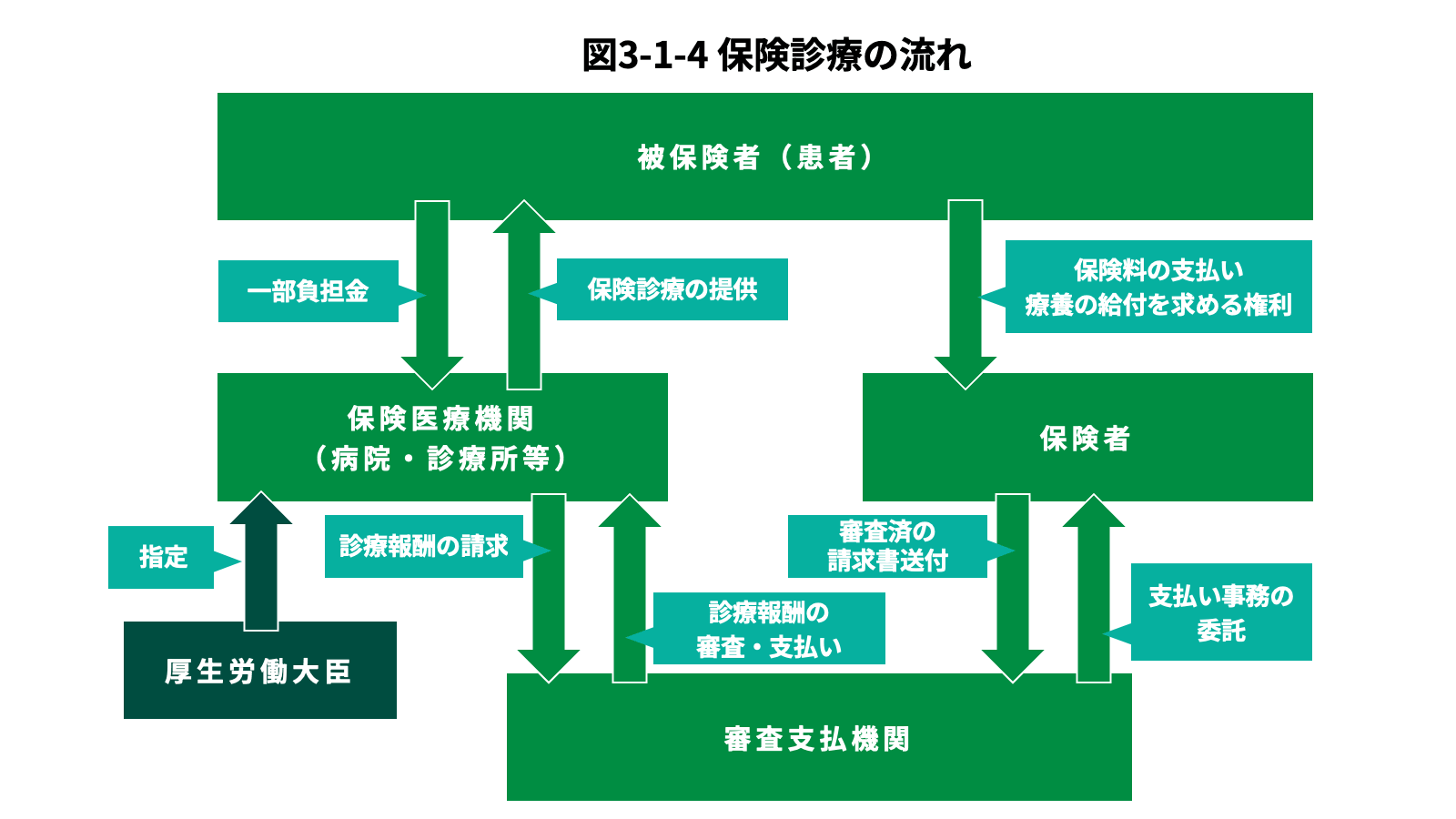
The flow of insured medical care is illustrated in Figure 3-1-4. When an insured person visits a medical institution, they pay the out-of-pocket portion of the medical costs for the services received directly to the institution at the point of care. The remaining 70–90% of the medical costs, after deducting the patient’s share, are claimed by the medical institution from the insurer. However, in practice the process of submitting medical fee claims is both large in volume and highly specialized. Consequently, this task is delegated to specialized organizations known as claims review and payment bodies, namely the Social Insurance Medical Fee Payment Fund (hereafter, the Payment Fund) and the National Health Insurance Federation (hereafter, NHI Federation).
These claims review and payment bodies examine the appropriateness of the submitted claims, request payment of the approved medical fees from the medical insurers, receive the payments from the insurers, and subsequently disburse the medical fees to the medical institutions. In other words, their role is to review the medical fee statements (receipts) submitted by medical institutions and, based on the results of this review, to carry out the payment of medical fees.
Claims Review and Payment Organizations
Claims review and payment organizations established in each prefecture are responsible for tasks such as transmitting claims to insurers and processing medical fee claims submitted by medical institutions. The term “processing” is used here because, in principle, the review and payment of medical fee claims is a function that insurers themselves should perform. Under the original framework, insured medical institutions that provide services to patients submit claims for medical fees directly to insurers after delivering care, and claims review and payment constitute one of the core functions of insurers.
However, in order to ensure the smooth and efficient payment of medical fees, the Social Insurance Medical Fee Payment Fund and the National Health Insurance Federation were established on a prefectural basis, and a system has been adopted whereby the administrative tasks related to the payment of medical fees are delegated to these organizations.
The purpose of the review conducted by claims review and payment organizations is to verify whether the medical services provided by medical institutions to individual patients comply with the regulations governing insured medical care, including the Rules for Medical Care for the Insured and related notifications. Although such reviews are, in principle, conducted in accordance with a single national set of regulations, disparities between branches, referred to as “inter-branch variation”, have been identified as an ongoing issue, whereby the criteria used to assess the appropriateness of claims differ across regional branches.[13]
- [1] Health Insurance Association Federation, Basic Knowledge of the Medical Insurance System. http://www.kenporen.com/health-insurance/m_knowledge/
- [2] Ministry of Health, Labour and Welfare, Basic Materials on Medical Insurance: Status of Medical Expenditure, FY2022. https://www.mhlw.go.jp/content/kiso_r04.pdf
- [3] Ministry of Health, Labour and Welfare, On Reform of the Medical Insurance System. https://www.kantei.go.jp/jp/singi/syakaihosyou_kaikaku/dai4/siryou2.pdf
- [4] Ministry of Health, Labour and Welfare, Medical Insurance in Japan. http://www.mhlw.go.jp/stf/seisakunitsuite/bunya/kenkou_iryou/iryouhoken/iryouhoken01/index.html
- [5] Ministry of Health, Labour and Welfare, Japan’s Medical Insurance System. http://www.mhlw.go.jp/file/06-Seisakujouhou-12400000-Hokenkyoku/0000172084.pdf
- [6] Ministry of Health, Labour and Welfare, For Those Using the High-Cost Medical Expense Benefit System. http://www.mhlw.go.jp/file/06-Seisakujouhou-12400000-Hokenkyoku/0000161153.pdf
- [7] Ministry of Health, Labour and Welfare, High-Cost Medical Expense Benefit System. https://www.mhlw.go.jp/content/12401000/001492935.pdf
- [8] Ministry of Health, Labour and Welfare, Medical Insurance in Japan. http://www.mhlw.go.jp/stf/seisakunitsuite/bunya/kenkou_iryou/iryouhoken/iryouhoken01/index.html
- [9] Ministry of Health, Labour and Welfare, About Japan’s Medical Insurance System. http://www.mhlw.go.jp/stf/seisakunitsuite/bunya/kenkou_iryou/iryouhoken/iryouhoken01/index.html
- [10] Ministry of Health, Labour and Welfare, Basic Materials on Medical Insurance — Status of Medical Expenditure, FY2022. https://www.mhlw.go.jp/content/kiso_r04.pdf
- [11] Ministry of Health, Labour and Welfare, Cost Sharing (Total Remuneration-Based Contribution). http://www.mhlw.go.jp/file/05-Shingikai-12601000-Seisakutoukatsukan-Sanjikanshitsu_Shakaihoshoutantou/0000140159.pdf
- [12] Ministry of Health, Labour and Welfare, About the Medical Fee Schedule System. http://www.mhlw.go.jp/bunya/iryouhoken/iryouhoken01/dl/01b.pdf
- [13] Ministry of Health, Labour and Welfare, Outline of the Plan for Enhancing Efficiency and Sophistication of the Claims Payment Fund’s Operations. http://www.mhlw.go.jp/file/06-Seisakujouhou-12400000-Hokenkyoku/0000169999.pdf
3.2 Japan’s Long-Term Care Insurance System
Overview of the Long-Term Care Insurance System
Japan’s Long-Term Care Insurance (LTCI) system is a social insurance scheme designed to support long-term care for the elderly through collective societal responsibility. It was introduced in 2000 and is administered by municipalities, which serve as the insurers. All residents aged 40 and over are insured under the system. As of April 2024, more than 6.6 million people were receiving services under the LTCI scheme.[14]
Background to the Establishment of the Long-Term Care Insurance System
Under the previous elderly welfare system, municipalities were the primary decision-makers regarding service provision. As a result, users were unable to choose services freely, and service content tended to be standardized (the so-called “placement-based system”). In addition, service utilization was subject to means-based contributions, which imposed a heavy burden on middle- and high-income groups, and long-term hospitalization in general hospitals for care-related reasons became a serious issue. Furthermore, the division of elderly care into separate systems for elderly welfare and elderly medical care also resulted in structural problems.
With the progression of population ageing, care needs increased significantly due to a growing number of older persons requiring care and the lengthening of care periods. At the same time, changes in family structures, such as the rise of nuclear families and the ageing of family caregivers, altered the circumstances surrounding families that had traditionally supported older persons in need of care.[15]
In light of these issues inherent in the former elderly welfare and medical care systems, the Long-Term Care Insurance system was established as a mechanism through which society as a whole shares responsibility for supporting long-term care for older persons.
Fundamental Principles of the Long-Term Care Insurance System
Support for Independence
Going beyond the provision of assistance with daily activities, the system aims to support the independence of older persons.
User-Centered Approach
Users are able to choose and receive comprehensive health, medical, and welfare services from a diverse range of providers.
Social Insurance Model
The system adopts a social insurance framework in which the relationship between benefits and contributions is clearly defined.
Insured Persons and Premiums
Insured persons under the LTCI system are divided into two categories: those aged 65 and over (Category I insured persons), and those aged 40 to 64 who are enrolled in a medical insurance scheme (Category II insured persons).
Category I Insured Persons
Individuals aged 65 and over are eligible to receive long-term care services upon being certified as requiring long-term care or support, regardless of the underlying cause.
Category II Insured Persons
Individuals aged 40 to 64 are eligible to receive services only when they are certified as requiring long-term care or support due to age-related diseases (specified diseases).
As of March 2023, the number of Category I insured persons stood at 35.85 million, while the monthly average number of Category II insured persons during fiscal year 2021 was 41.85 million.[16][17]
Premiums for Category I insured persons (aged 65 and over) are paid separately from medical insurance premiums. Premium levels are determined by each insurer (municipality) based on medium-term projections of service demand over a three-year period. At present, premiums are structured across 13 standard income-based tiers.[18] Premiums for Category II insured persons (aged 40 to 64) are collected together with medical insurance premiums, with rates set by the respective medical insurers.[19]
The rationale for setting the lower age threshold for LTCI coverage at 40 was the subject of considerable debate at the time of the system’s establishment. Proposals included limiting coverage to those aged 65 and over or extending it to those aged 20 and over. However, the 1996 outline proposal for the Long-Term Care Insurance system submitted to the Council on Health and Welfare for the Elderly argued that individuals aged 40 and over are more likely to require social support through long-term care insurance as family members caring for their parents. On this basis, it was decided that persons aged 40 and over should be insured, with care costs shared through social solidarity. These discussions ultimately shaped the current framework of the LTCI system.
Financing of the Long-Term Care Insurance System
As shown in Figure 3-2-1, the LTCI system is financed equally by insurance premiums (50%) and public funding (50%). Under the draft budget for fiscal year 2024, total long-term care benefit expenditure amounts to ¥13.2 trillion. This comprises ¥3.0 trillion from Category I insured persons, ¥3.6 trillion from Category II insured persons, ¥3.1 trillion in national government contributions, ¥1.9 trillion in prefectural contributions, and ¥1.6 trillion in municipal contributions.
As with medical expenditure, long-term care benefit expenditure has continued to reach record highs each year. It is expected to increase further in the future as population ageing progresses.[20]
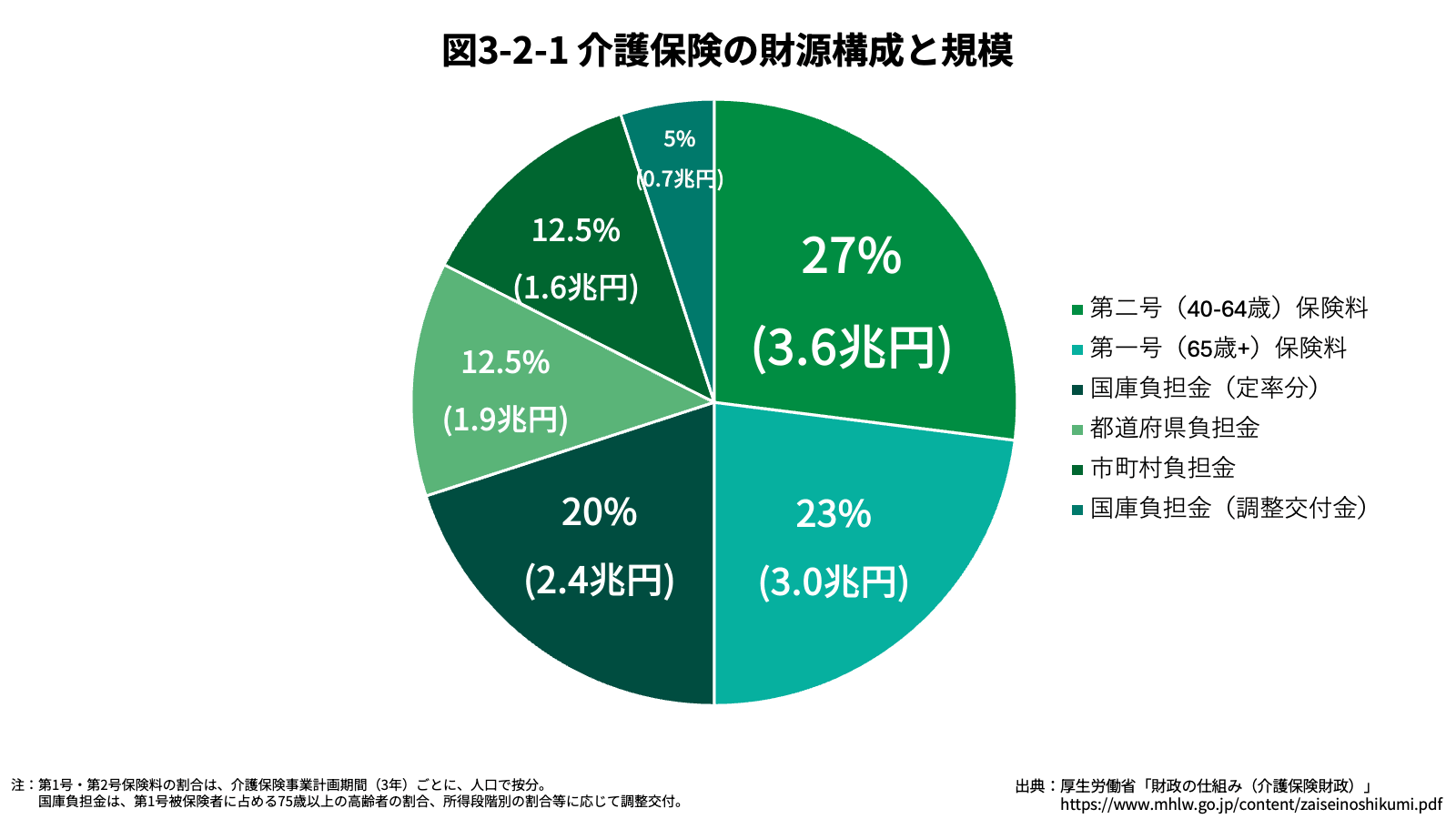
Fiscal measures are also in place to address disparities in financial burden. Specifically, fiscal adjustment is carried out using 5% of the national government contribution (which accounts for 26% in total) to offset both the increase in benefit expenditure resulting from a high proportion of late-stage elderly persons and the decrease in revenue resulting from the lower income levels of insured persons. Through this mechanism, disparities in fiscal capacity among municipalities are mitigated. In this respect, the fiscal adjustment framework resembles the inter-insurer fiscal adjustment mechanism in the elderly medical care system described in Section 1.2, in that both systems are designed to correct differences in “fiscal capacity” among insurers.
Use of Long-Term Care Services and Certification of Care Needs
In order to use long-term care services, individuals must apply at a municipal office or a Community General Support Center and obtain certification indicating the need for care, known as “support need certification” or “care need certification.” Once certified, a care manager formulates a care plan, enabling the individual to receive a range of long-term care services covered by long-term care insurance.
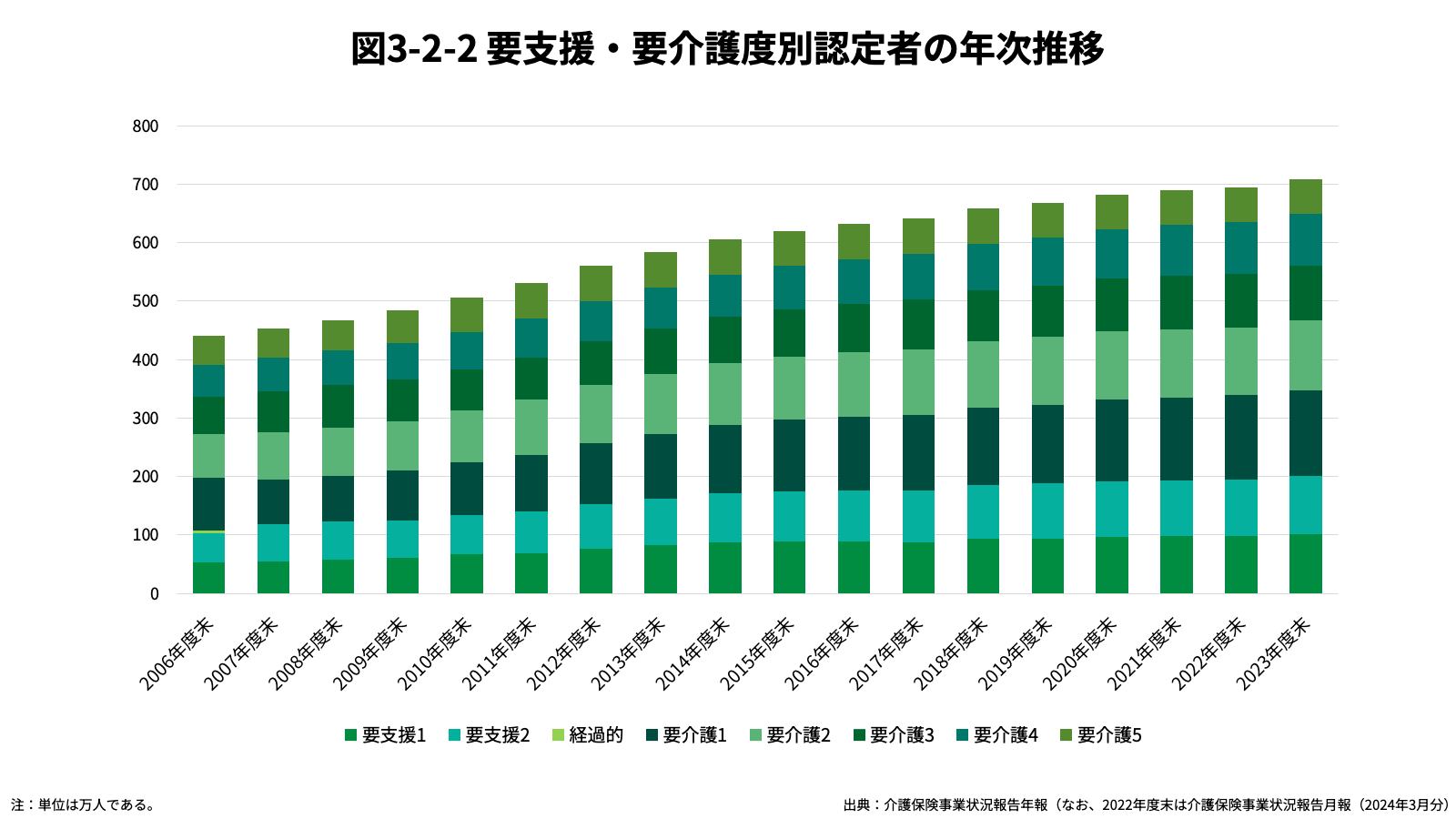
Certification is determined by an expert committee based on a survey comprising 74 items related to activities of daily living, as well as a medical certificate provided by healthcare professionals. The level of care need is classified into one of seven categories: Support Level 1 or 2, or Care Level 1 through 5. The certification period is, in principle, six months for initial certification and twelve months for renewals. Reassessments may be conducted at any time if the individual’s condition deteriorates.[21] Annual trends in the number of certified persons requiring care are shown in Figure 3-2-2.
In the 2006 revision of the Long-Term Care Insurance Act, preventive care services were newly introduced in response to the continuous increase in the number of insured persons certified as having mild care needs (Support Level or Care Level 1), which had not led to improvements in care dependency. At that time, individuals previously certified as Care Level 1 were reassessed and reclassified as either “Care Level 1” or “Support Level 2,” depending on the potential for maintaining or improving their condition. This classification framework has remained in place to the present day.
- [14] Ministry of Health, Labour and Welfare, Summary of the FY2023 Survey on Long-Term Care Benefit Expenditure. https://www.mhlw.go.jp/toukei/saikin/hw/kaigo/kyufu/23/dl/11.pdf
- [15] Ministry of Health, Labour and Welfare, The Current Status and Future Role of the Public Long-Term Care Insurance System. http://www.mhlw.go.jp/file/06-Seisakujouhou-12300000-Roukenkyoku/201602kaigohokenntoha_2.pdf
- [16] Ministry of Health, Labour and Welfare, Summary of the FY2022 Annual Report on Long-Term Care Insurance Services. https://www.mhlw.go.jp/topics/kaigo/osirase/jigyo/22/dl/r04_gaiyou.pdf
- [17] Ministry of Health, Labour and Welfare, About Long-Term Care Insurance Premiums for Category II Insured Persons. https://www.mhlw.go.jp/topics/kaigo/osirase/jigyo/21/dl/r03_hihokensha.pdf
- [18] Ministry of Health, Labour and Welfare, On Benefits and Cost Sharing. https://www.mhlw.go.jp/content/12300000/001182065.pdf
- [19] Ministry of Health, Labour and Welfare, About the Long-Term Care Insurance System. http://www.mhlw.go.jp/file/06-Seisakujouhou-12300000-Roukenkyoku/2gou_leaflet.pdf
- [20] Ministry of Health, Labour and Welfare, Trends in Total Long-Term Care Insurance Expenditure. https://www.mhlw.go.jp/content/zaiseinoshikumi.pdf
- [21] Ministry of Health, Labour and Welfare, About the Long-Term Care Insurance System. http://www.mhlw.go.jp/file/06-Seisakujouhou-12300000-Roukenkyoku/2gou_leaflet.pdf
3.3 Private Health Insurance
The Role of Private Health Insurance under the Universal Health Insurance System
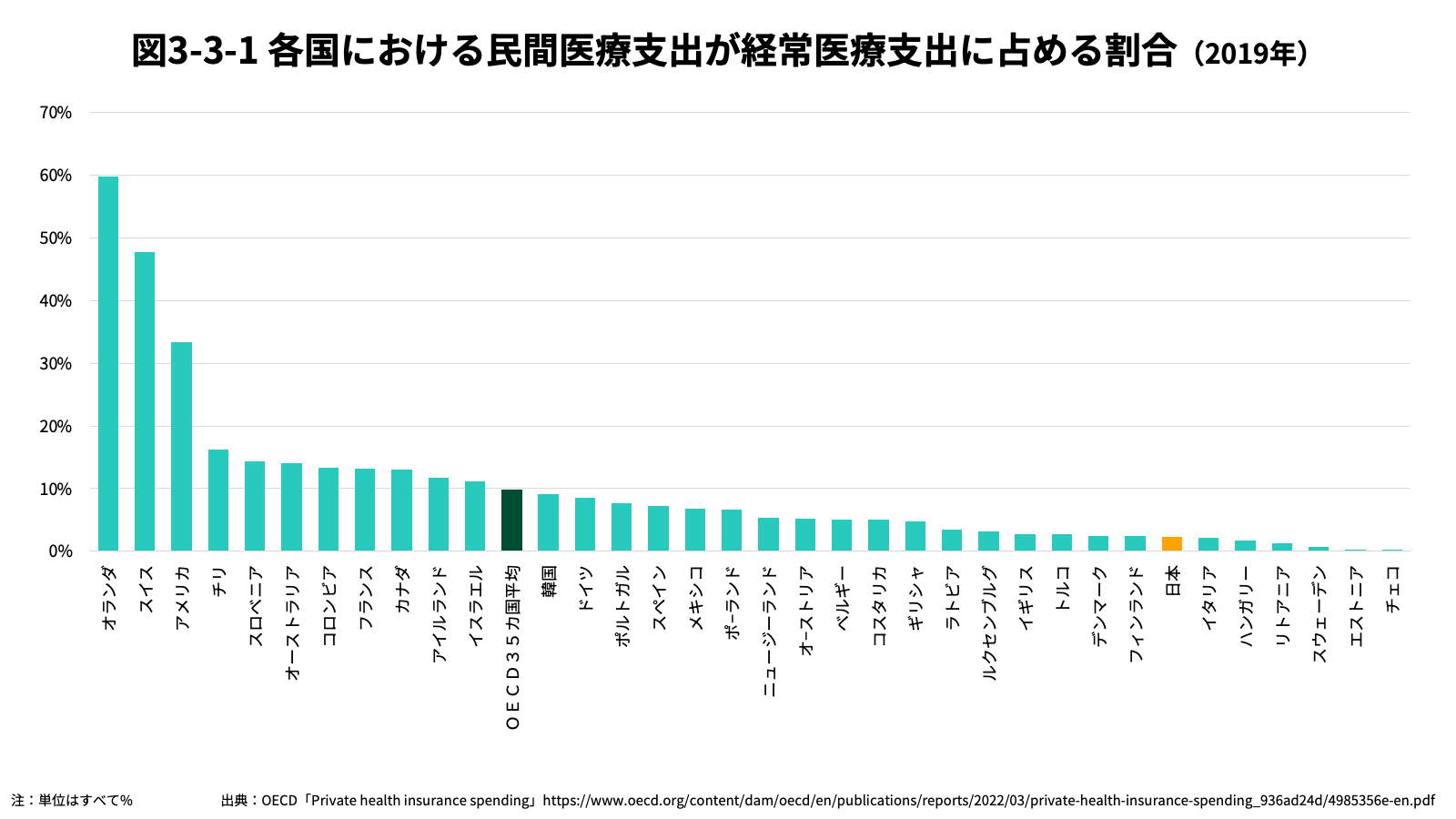
In Japan, the scope of benefits covered by the public health insurance system is broad, and patients enjoy free access to medical institutions. As a result, private health insurance primarily serves a supplementary role to the public medical insurance system. Owing to factors such as the High-Cost Medical Expense Benefit System and the prohibition of mixed billing.[22] The role played by private health insurance remains limited compared with that in other countries. The share of private health expenditure in Japan stands at 2.3%, placing it among the lowest levels within OECD countries (Figure 3-3-1).[23]
The current size of Japan’s private health insurance market is approximately JPY 7 trillion (JPY 7.2 trillion as of 2023) and has been increasing steadily year by year.[24] In concrete terms, private health insurance primarily provides coverage for services that fall outside the scope of public insurance benefits, compensation for ancillary expenses incurred at the time of illness, and income protection in the event of work absence.[25][26][27]
At the same time, changes in disease patterns, the growing emphasis on cancer care,[28] and the expansion of advanced medical treatments have led to shifts in demand for private health insurance. Furthermore, against the backdrop of a declining birth rate, population ageing, technological innovation, and relatively low levels of out-of-pocket payments, national medical expenditure has continued to rise annually. This has raised the possibility that the scope of public health insurance coverage may be revised, with potential modifications or reductions in covered services. In light of these developments, the future role of private health insurance is likely to evolve in response to the direction and substance of reforms to the public health insurance system.[29][30] While most private health insurance products currently available on the market provide limited, standardized, lump-sum monetary benefits, the role of private insurance in covering medical services outside the scope of public insurance may expand in the future.
Background to the Rapid Growth of the Private Health Insurance Sector
In the post-war period, Japan’s private insurance industry operated under extensive government regulation, resulting in uniform insurance products and business practices (the so-called “convoy system”). However, as trade liberalization with other countries progressed from the 1960s onwards, the insurance sector also came under pressure to allow market entry by foreign insurers. Consequently, in the early 1970s, the life insurance market was partially liberalized, limited to so-called “third-sector insurance”, including medical and cancer insurance, which at the time were relatively underdeveloped domestically. As a result, the third-sector insurance market[31] came to be dominated by foreign insurers. Following a comprehensive revision of the Insurance Business Act in 1995, the full liberalization of the third-sector insurance market in 2001 allowed all domestic insurance companies to enter this field.[32] Thereafter, the third-sector insurance market expanded rapidly over a short period and has since become one of the most highly competitive segments of the insurance industry.
In recent years, new types of products known as “simplified underwriting health insurance” have emerged, targeting individuals with pre-existing conditions or medical histories who previously found it difficult to obtain coverage. These products have enabled middle-aged and older individuals with health conditions to prepare for the financial risks associated with hospitalization and surgery. In addition to diversification in insurance products, sales channels have also expanded, with the increased use of online distribution methods and the deregulation of sales through banks and securities companies. More recently, in response to medium- to long-term demographic changes and increasingly diverse consumer needs, insurers have strengthened their business activities not only in traditional insurance domains but also in related areas such as long-term care and healthcare services.[33]
Against this background, the number of in-force private health insurance contracts has continued to increase annually. In 2023, the number of health insurance policies providing coverage for hospitalization and surgical procedures under the main contracts of all life insurance companies reached 44.92 million.[34]
- [22] In Japan, mixed medical treatment (混合診療) refers to receiving both insurance-covered care (hoken shinryo, 保険診療) and non-insurance-covered care (jiyu shinryo, 自由診療) at the same time. Under the principle of non-coverage for mixed treatment (混合診療保険適用外の原則), mixed treatment is generally prohibited. As a result, patients usually cannot combine insured and uninsured services in a single episode of care. However, since 2006 the system of insured–uninsured combined medical expenses (保険外併用療養費制度) has been established. Under this system, certain advanced medical services that are not yet covered by public insurance but are intended for future inclusion may be provided alongside insured treatment under specific rules. For such cases, where safety and effectiveness have been confirmed according to prescribed criteria, limited combinations of insured and uninsured services are permitted. This mechanism allows experiments with advanced care options before formal insurance coverage is established.
- [23] OECD, Private Health Insurance Spending. https://www.oecd.org/content/dam/oecd/en/publications/reports/2022/03/private-health-insurance-spending_936ad24d/4985356e-en.pdf
- [24] Life Insurance Association of Japan, Trends in Life Insurance 2024 Edition. https://www.seiho.or.jp/data/statistics/trend/pdf/all_2024.pdf
- [25] Tajika, Eiji & Kikuchi, Jun, The Roles of Government and Private Insurance in Medical Coverage: Theoretical Frameworks and International Case Studies. http://www.mof.go.jp/pri/publication/financial_review/fr_list6/r111/r111_02.pdf
- [26] Nakahama, Takashi, The Role of Private Medical Insurance: A Comparison between Japan and the United States. https://www.jstage.jst.go.jp/article/jsis/2007/596/2007_596_596_69/_pdf
- [27] When a taxpayer pays premiums for life insurance, long-term care and medical insurance, or individual annuity insurance, they are eligible for a deduction from taxable income. This is known as the life insurance premium deduction, and it reduces the burden of both income tax and resident tax in proportion to the amount of insurance premiums paid.
- [28] Since 1981, cancer has ranked as the leading cause of death in Japan. According to the cause-specific mortality figures for 2022, cancer had the highest mortality rate at 316.1 deaths per 100,000 population, followed by heart disease at 190.8, and senility at 147.1. For further details, see: Summary of the 2022 Vital Statistics Monthly Report (Annual Total, Preliminary Figures). https://www.mhlw.go.jp/toukei/saikin/hw/jinkou/geppo/nengai22/dl/gaikyouR4.pdf
- [29] Nakahama, Takashi, The Role of Private Medical Insurance: A Comparison between Japan and the United States. https://www.jstage.jst.go.jp/article/jsis/2007/596/2007_596_596_69/_pdf
- [30] Kawaguchi, Hiroyuki, International Comparison of Public Medical Security Systems and Private Medical Insurance: Division of Roles between Public and Private Financing and Their Functions. http://www.seijo.ac.jp/pdf/faeco/kenkyu/196/196-kawaguchi.pdf
- [31] In Japan, insurance can broadly be classified into three categories: life insurance, non-life (property and casualty) insurance, and third-sector insurance. Third-sector insurance refers to a group of insurance products—such as medical insurance or cancer insurance—that do not fall under either life insurance or non-life insurance. (See: Nobuko Serizawa, The Third-Sector Insurance Market. http://dspace.lib.niigata-u.ac.jp/dspace/bitstream/10191/16657/1/90_249-271.pdf)
- [32] Serizawa, Nobuko, The Third-Sector Insurance Market. http://dspace.lib.niigata-u.ac.jp/dspace/bitstream/10191/16657/1/90_249-271.pdf
- [33] Financial Services Agency, 2024 Insurance Monitoring Report. https://www.fsa.go.jp/news/r6/hoken/20240703/02.pdf
- [34] Life Insurance Association of Japan, Trends in Life Insurance 2024 Edition. https://www.seiho.or.jp/data/statistics/trend/pdf/all_2024.pdf